Terroir & Ecology
Cloud, altitude, and a mountain that decides the tea
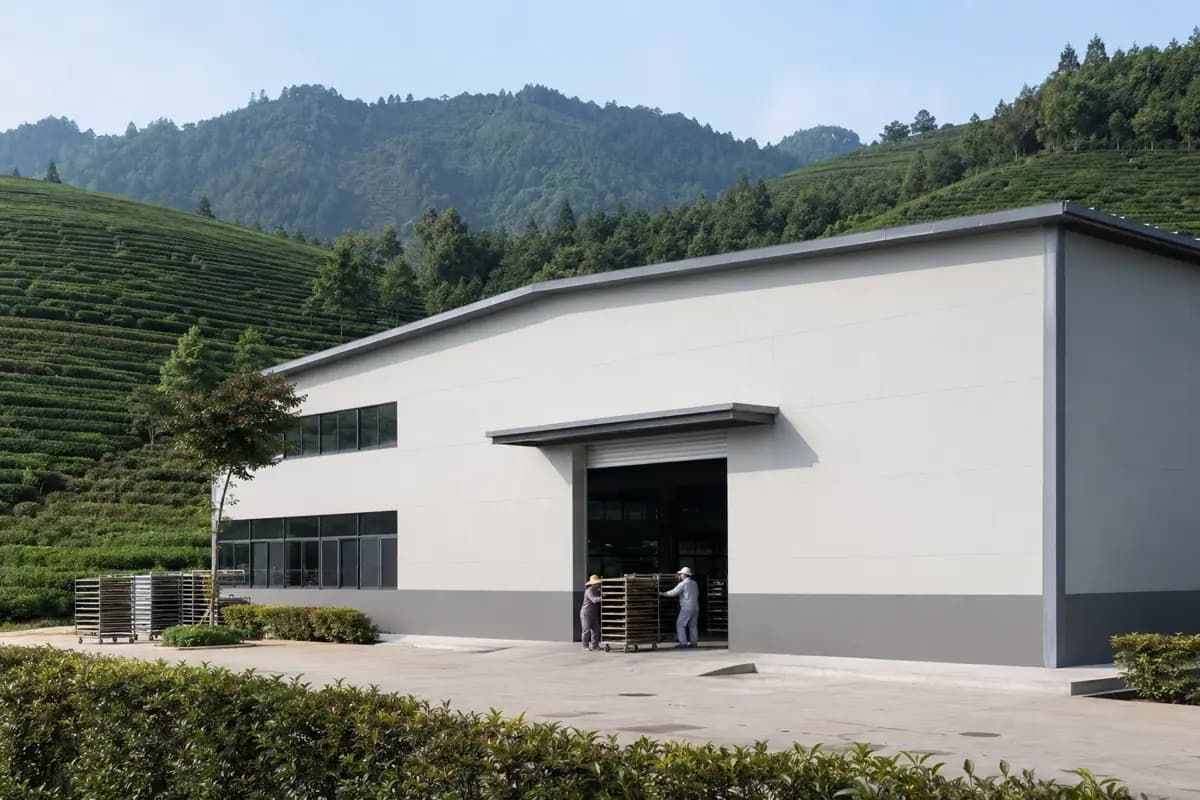
The Jishou gardens sit between roughly 500 and 800 metres in the Wuling mountains of western Hunan, on slopes that spend much of the growing season inside cloud. That fog is not scenery — it is the reason the leaf develops slowly enough to accumulate the amino acid concentration this origin is known for.
Terroir at a glance
- Altitude
- 500 – 800 m
- Gardens on mid-slope, not valley floor
- Range
- Wuling mountains
- Western Hunan, Xiangxi prefecture
- Growing environment
- Persistent cloud and fog
- Diffuse light through much of the spring flush
- Diurnal range
- Wide
- Cold nights slow metabolism; the leaf accumulates rather than spends
- Plantation area
- 150,000 mu
- ≈ 10,000 ha across the GI area, 2022
- Picking
- By hand
- Bud-and-leaf standard cannot be met mechanically
From the gardens
Twenty seconds, no voiceover
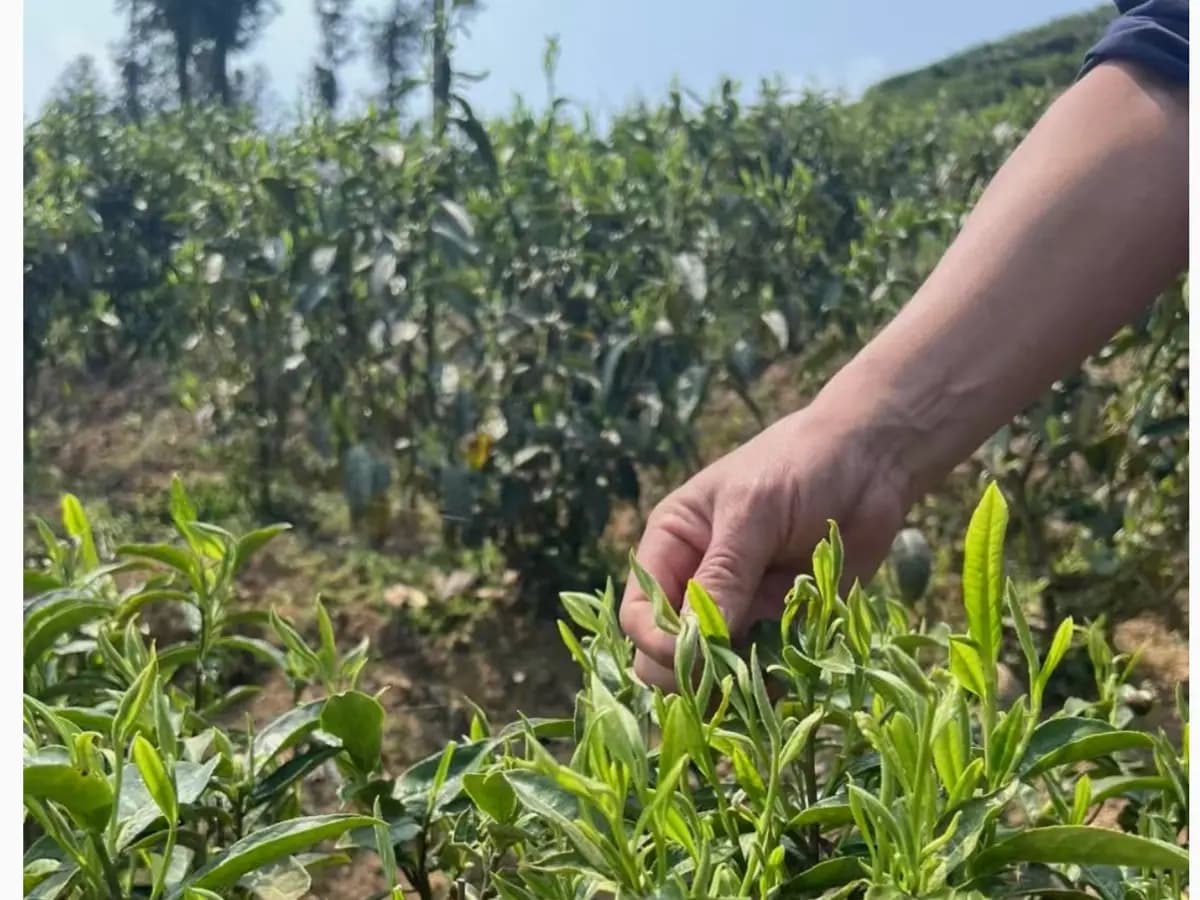
Most supplier videos talk at you. This one does not. What it shows is the whole commercial argument: a slope high enough to sit inside cloud, a garden small enough to be picked by hand, and two people doing exactly that.
- Where
- Jishou, Xiangxi
- 500 – 800 m, Wuling mountains
- How
- By hand
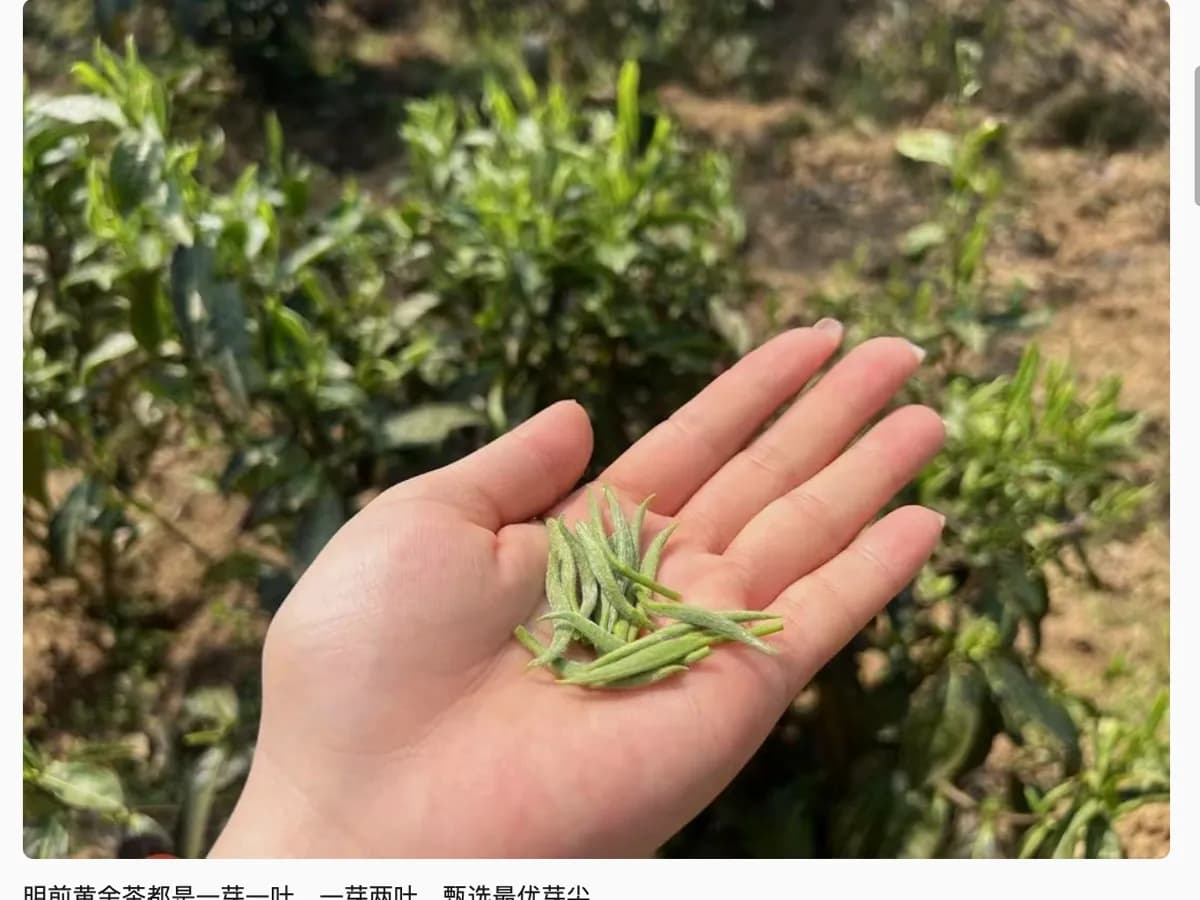
- One bud and one leaf
- When
- Two weeks
- The pre-Qingming window, once a year
Ecology
The mountain does the work
What the fog actually does
Tea grown under persistent cloud receives diffuse rather than direct light. Diffuse light slows photosynthetic conversion, which means the plant converts fewer of its amino acids — principally theanine — into catechins. Cold nights compound the effect by slowing metabolism further.
The result is a leaf that accumulates rather than spends. This is the mechanism behind the published figure of 7.8% amino acids for this cultivar, roughly twice comparable cultivars from the same harvest period, and it is why the cup reads as sweet rather than brisk.
It is also why the same gardens cannot produce this character in July. By midsummer, light and temperature have reversed all three conditions.
Forest at the edge of every garden
The gardens here are not a monoculture plain. They are cut into slopes that remain bordered by mixed woodland — the terraces follow the contour of the hill rather than flattening it, because flattening these gradients is not practical.
That constraint has a consequence worth stating plainly: garden blocks stay small and separated by standing vegetation. Small blocks bordered by woodland behave differently from continuous monoculture, and they are also what makes plot-level traceability possible in the first place.
Low intervention, because the economics require it
The commercial logic here runs in the right direction. This origin's entire value rests on a composition figure that heavy intervention would flatten, and on a picking standard — one bud and one leaf — that only hand-picking can meet.
So the gardens are hand-picked, block by block, over a picking window measured in days rather than months. Nothing about that is romantic; it is simply what the product requires. But it does mean the practices and the quality argument point the same way.
The season decides, not the sales calendar
Pre-Qingming green tea exists for about two weeks a year. Post-Qingming black tea runs from mid-April to late May. Summer leaf makes commercial grades and nothing else.
We do not offer a pre-Qingming lot in October, because there is not one. A supplier who can always sell you spring tea is selling you something else.
1200×900
- Species
- Camellia sinensis (L.) O. Ktze
- Ancient trees registered
- 2,057 individually recorded
- Ancient gardens
- 7, dating from the Ming and Qing dynasties
- Age range
- 74 – 414 years
- Oldest tree
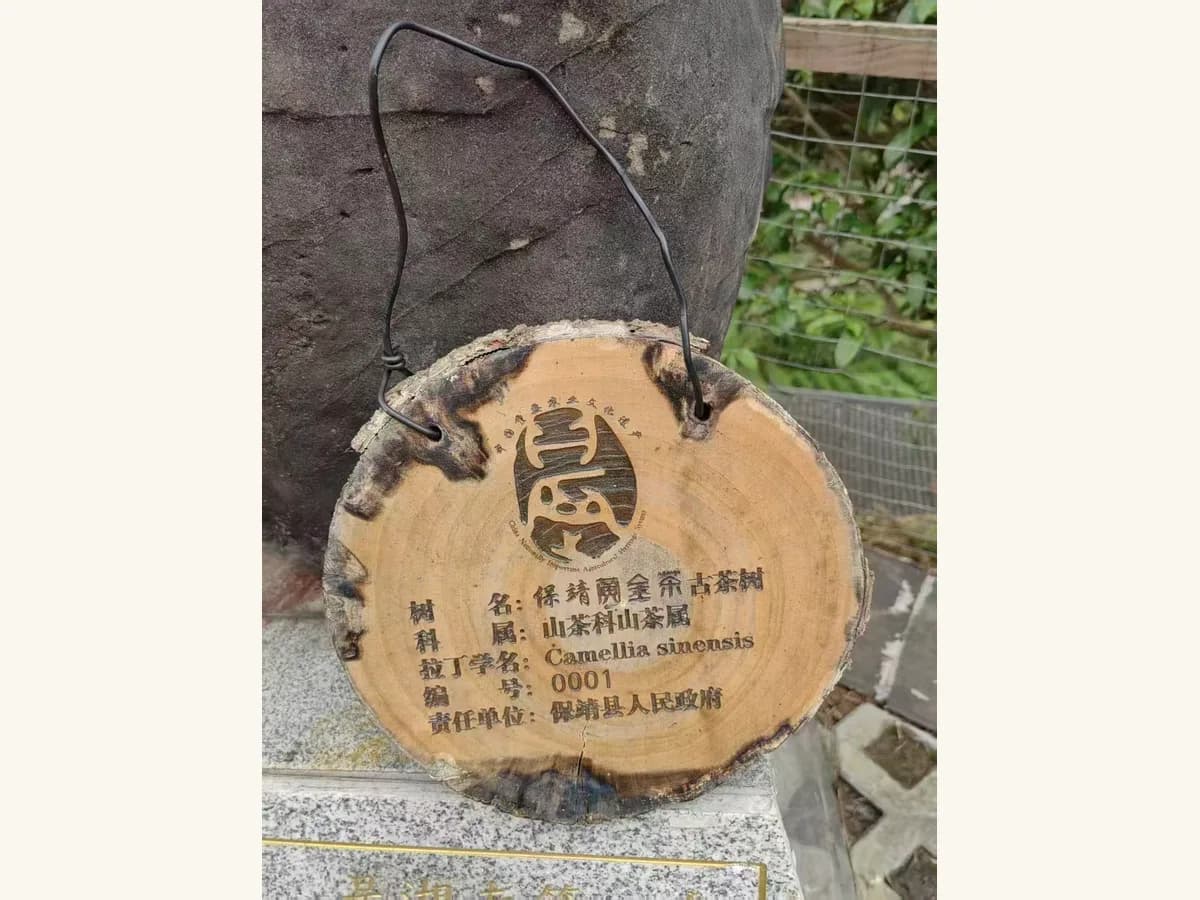
- No. 0001
- Heritage status
- China Nationally Important Agricultural Heritage System, 5th batch, 2020
- Protection grade
- First class; may not be damaged, felled or transplanted
- Registered by
- County people's government, Xiangxi prefecture, Hunan
Ancient trees
The mother trees of this cultivar
The Huangjincha cultivars we work with — No.1, No.2 and No.8 — were not bred in a laboratory. They were selected from a surviving population of ancient tea trees in Baojing County, in this same prefecture: 2,057 individual trees across seven old gardens, dating from the Ming and Qing dynasties, every one of them individually registered and recorded. Their ages run from 74 to 414 years.
In 2020 that landscape — the ancient tea gardens of Baojing and the tea culture around them — was designated in the fifth batch of China's Nationally Important Agricultural Heritage Systems. Individual trees carry two markers: a provincial ancient-tree protection plate with a register number and protection grade, and a wooden heritage plaque. The tree numbered 0001 is the oldest of them.
This matters for a specific and limited reason. It is the documented origin of the plant material, not a claim about our own designation: our tea is sold as Xiangxi Golden Tea under certification mark 15887938, and we do not claim the separate Baojing designation. What the ancient gardens establish is that these cultivars come from a tea population that was already old when the 1539 record was written — and that this is a public, registered fact rather than a story we are telling you.
We do not pick from protected trees and we do not sell their leaf — the plaques themselves prohibit it. They appear here as the documented ancestry of the cultivars we grow, and as evidence that this is an old tea landscape rather than a recently planted one.
The year
Four seasons, and only one of them makes spring tea
Winter 冬
December – February
The bushes rest. Cold sets the following spring's chemistry; a mild winter shows up in the cup four months later.
Allocation for the coming season is agreed with each farming family. Buyers planning a spring lot need to be in this conversation.
Early spring 早春
Late March – early April
The first buds break. The pre-Qingming window opens and closes within about two weeks.
Hand-picking, block by block, at one bud and one leaf. Green tea is fired the same day it is picked.
Late spring 暮春
Mid-April – late May
Growth accelerates and the leaf gains body. The gardens switch from green to black tea.
Withering, rolling, oxidation, drying. The imperial and premium black grades are made in this window.
Summer & autumn 夏秋
June – September
High light and heat. Polyphenols rise, amino acids fall — a different leaf from a different season.
Commercial grades and teabag cut. Honest volume tea, priced as volume tea.
Verification
What we can prove, and what we will not claim
Green marketing is cheap. The list on the right is the part that matters commercially — a supplier who is precise about the limits of their claims is easier to underwrite than one who is not.
What we can prove
Multi-residue analysis before shipment
Every lot is screened against the EU panel under Regulation (EC) 396/2005 before it leaves. The report references the lot number printed on the cartons. This is verifiable by you, on your own sample, at your own laboratory.
Plot, altitude and picking date
Each lot carries a garden reference, an altitude, a cultivar, a picking date and a batch number. Blocks are processed separately rather than pooled, which is what makes the record meaningful.
A geographical indication in two public registers
Xiangxi Golden Tea is protected under the Chinese geographical-indication certification mark register (27 July 2020) and holds China's registration 15887938. You can check both without asking us.
Composition data you can reproduce
The 7.8% amino acid figure is a laboratory measurement of the cultivar, not a marketing number. Send a sample to your own lab.