Articles
Auditing a Chinese Tea Supplier: What to Actually Check
Written by a supplier, which makes it worth reading carefully: these are the checks we would want a serious buyer to run on us, and the answers that should make you walk away.
Updated 2026-08-03 · 12 min read
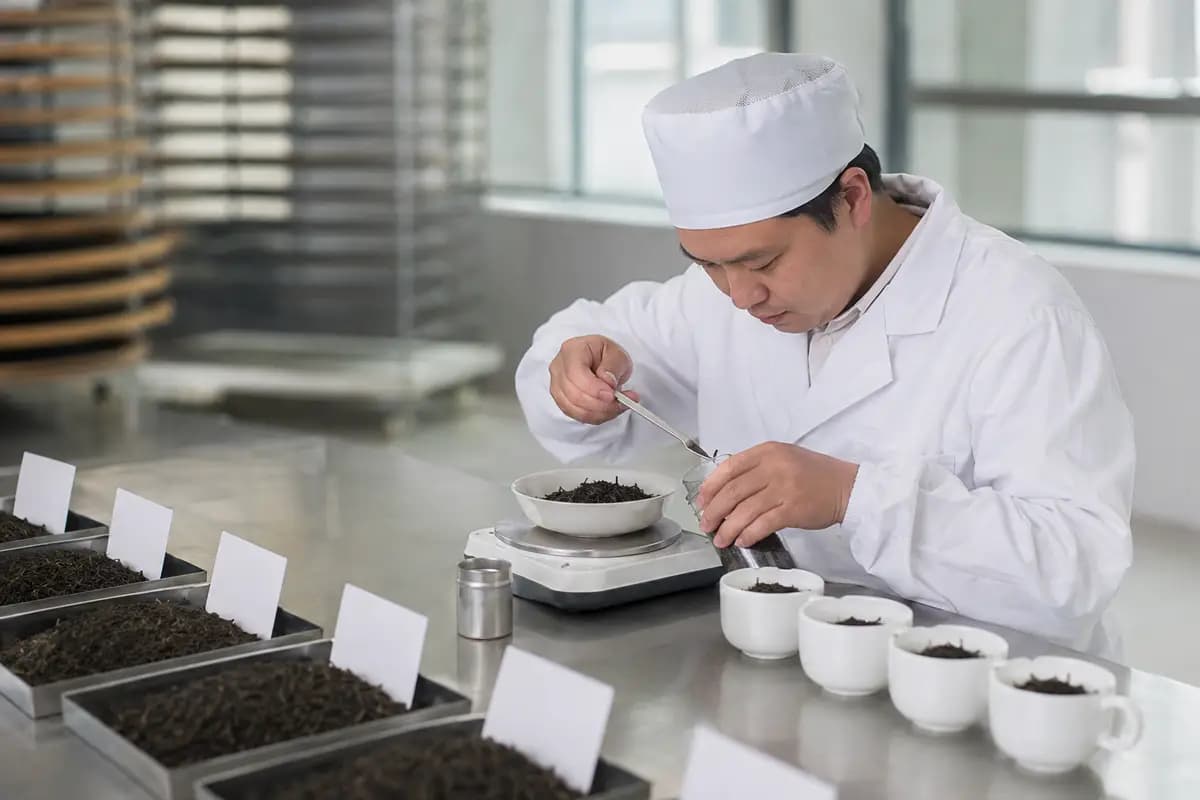
Auditing a tea supplier means verifying three separate things: that the company is who it says it is, that it controls what it claims to control, and that the specific tea you are buying is what the paperwork says. Most buyers check the first, assume the second, and discover the third after the container has landed.
We are writing this as a supplier. That is a conflict of interest and you should read it accordingly — but it also means the checklist below is the one we would want a serious buyer to run on us, rather than the one that happens to flatter us.
Stage 1 — What you can verify before any conversation
| Claim | How to check it | What a failure means |
|---|---|---|
| The company legally exists | Chinese business registration number, verifiable in the public company register | Ends the conversation |
| It holds import-export rights | Ask directly; many producers do not, and use a trading company | Not a failure — but you must know who your contract is with |
| A geographical indication claim | The registration number, searchable in the Chinese trademark register | A GI named without a number is decoration |
| An organic or certification claim | Certificate number and certifying body, checkable on the body's own database | A logo without a checkable number is a red flag |
| FDA registration (for US buyers) | Registration number and current renewal status | Cannot ship to the US without it |
The pattern to look for is not whether a claim is impressive but whether it is checkable. "Award-winning" is not checkable. "Rated by the Jishou Tea Industry Association expert panel on 11 July 2026" is — there is a body, a date, and a document you can ask to see.
Stage 2 — Questions that reveal how they actually operate
- Do you own the gardens, contract them, or buy on the spot market? Each is legitimate; only one of them supports plot-level traceability.
- Which specific processing steps happen in your own facility, and which are contracted out?
- Can you trace this sample back to a plot and a picking date? Show me.
- What was your last shipment refused or downgraded for, and what did you change?
- Who is the exporter of record, and is that the same legal entity as the producer?
Question four is the one that matters most, and the only one where a confident answer is a bad sign. Every real producer has had a lot go wrong. A supplier who says nothing has ever been rejected is telling you either that they do not test, or that they are willing to say untrue things early in a relationship. Neither is a good start.
Stage 3 — On the factory visit
If you can visit, go during production. A factory tour in the off-season shows you clean idle machinery and tells you almost nothing. What to look at:
- Withering troughs in use — depth of leaf, airflow, whether temperature is monitored or guessed.
- The oxidation room — whether conditions are controlled and recorded, or judged by eye alone. Both can make good tea; only one is repeatable.
- The sorting line — how much is mechanical, how much is hand work, and how many people are actually on it.
- The retained-sample cabinet. This is the single most revealing thing in a tea factory. A supplier who keeps sealed reference samples by lot and date can defend consistency claims; one who does not, cannot.
- The finished-goods store — pallet condition, whether cartons sit on the floor, whether green and black tea are stored together.
- The laboratory or, more commonly, the file of third-party laboratory reports.
Ask to see the retained samples for a lot they shipped six months ago, and cup it against what they are offering you now. That single request tells you more about a supplier's quality system than a full day of presentations.
Stage 4 — Verifying the actual tea
| Document | What to look for |
|---|---|
| Certificate of analysis | Named laboratory, stated method, lot number matching the shipment |
| Pesticide report | Screened against your destination's standard, all detections reported |
| Certificate of origin | Issuing body, and consistency with the origin claim on the label |
| Phytosanitary certificate | Issued for the actual consignment, dates consistent with production |
| Retained sample | Sealed, labelled with lot and date, held by both parties |
Cross-check the dates. A certificate of analysis issued before the stated picking date, or a phytosanitary certificate that predates production, means the paperwork is generic rather than specific to your lot. That is a more common finding than outright falsification and it has the same practical consequence: the documents do not describe your tea.
Answers that should end the conversation
- A certification claimed without a number, or with a number that does not resolve in the issuing body's register.
- "Organic" used without a certificate — in most markets this is a regulated term, and using it wrongly makes the importer liable.
- Refusal to name the exporter of record.
- A certificate of analysis that cannot be traced to a named laboratory.
- Agreement to every line of an unfamiliar specification without a single qualification.
- Health claims about tea. In the EU these are governed by Regulation (EC) 1924/2006, and a supplier who offers them casually will be equally casual about the claims you can be fined for.
That last one is worth dwelling on. A supplier volunteering health benefits is not being generous; they are showing you that they do not know the rules of your market, or do not care that the liability for the claim lands on you as the importer and brand owner.
A note on the limits of auditing
None of this guarantees a good outcome. Audits verify systems and documents; they do not taste the tea, and a supplier can pass every check above and still send you a mediocre lot. Pair the audit with retained samples, lot-by-lot testing on the first three shipments, and a written agreement about what happens when a lot fails. The paperwork tells you whether a supplier can be relied on. Only the tea tells you whether it should be.