Articles
Choosing Black Tea for Cold Brew and RTD Beverage Production
The tea that wins your hot cupping session is often the wrong tea for a bottled drink. Cold extraction, dilution, sweetening and a three-month shelf life each change what the leaf needs to do.
Updated 2026-08-03 · 11 min read
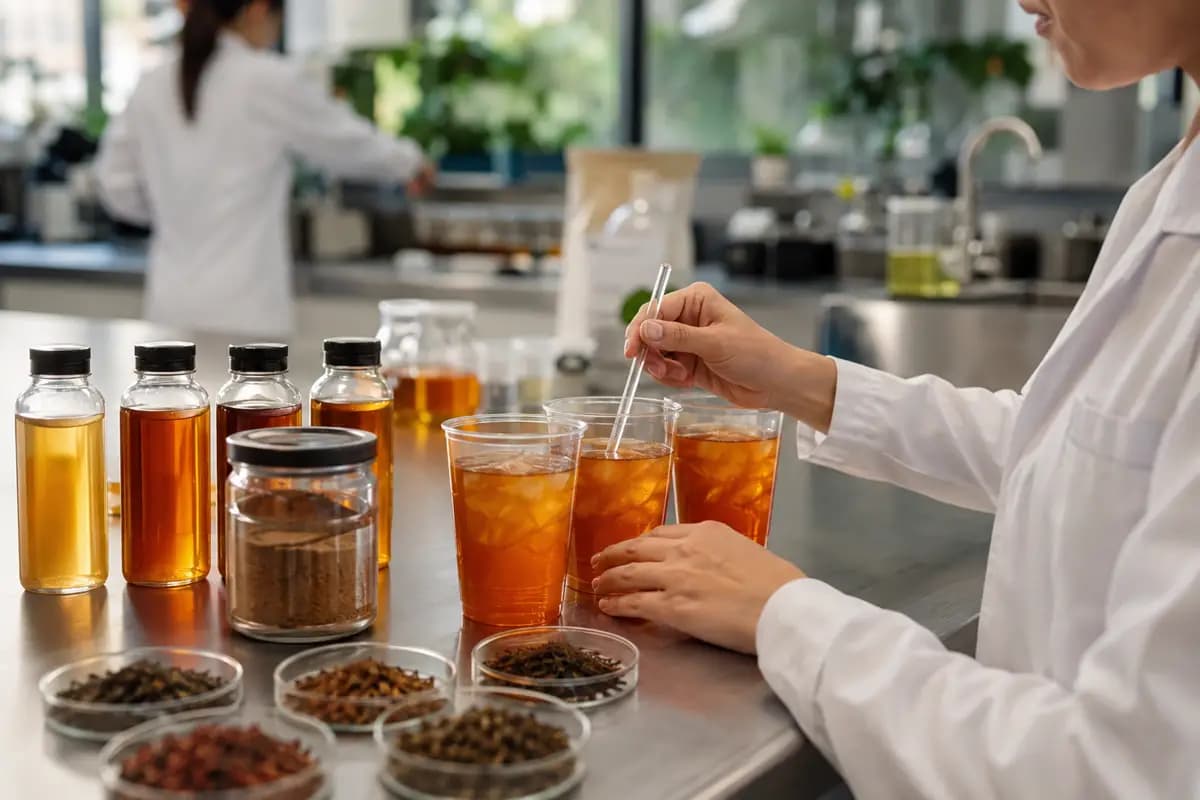
Choosing tea for a ready-to-drink beverage is a different exercise from choosing tea to be brewed and drunk immediately. The tea has to extract acceptably at low temperature or on a compressed hot-extraction line, survive dilution and sweetening without going thin, stay visually clear for the whole shelf life, and behave consistently across batches measured in tonnes. A leaf that is excellent in a gaiwan can fail all four.
Why cold extraction changes the answer
Cold water extracts tea components selectively. Compounds that carry sweetness and body come out relatively readily; the ones responsible for sharp astringency come out more slowly. This is why cold brew tastes smoother than the same leaf brewed hot and then chilled — it is a different extraction, not the same drink at a lower temperature.
The practical consequence for sourcing: teas with a naturally low astringency profile hold up better through long cold extraction, and leaf grades that would be considered too gentle for a strong hot cup can perform well. Higher amino acid content is associated with that lower-astringency character, which is one reason cultivars selected for it are worth trialling for cold applications.
Tea cream: the haze problem
Tea cream is the cloudiness that forms when hot tea extract cools. It is a physical association between polyphenols and caffeine, and it is the reason a bottled tea can leave the plant clear and reach the shelf hazy. It is not spoilage, but consumers read it as spoilage, which makes it a commercial problem regardless.
| Approach | How it works | Trade-off |
|---|---|---|
| Cold extraction | Extracts fewer of the compounds that associate on cooling | Longer process time, lower yield |
| Tannase treatment | Enzymatic modification of the polyphenols | Added ingredient and processing cost; may need declaring |
| Cold clarification and filtration | Chill, let cream form, filter it out | Removes some flavour and colour with it |
| Lower extract concentration | Less material available to associate | Weaker drink; often compensated with flavouring |
| Acidification | Lower pH keeps the complex dispersed | Changes taste; interacts with your flavour system |
Most commercial RTD tea uses more than one of these in combination. The relevant sourcing question is not "which tea does not cream" — all real tea creams — but how much extract you need to hit your target strength, because haze scales with concentration.
Water is an ingredient, and usually the largest one
A bottled tea is upwards of ninety-five percent water, so water chemistry is not a detail. Calcium and magnesium content changes extraction and can dull colour; alkalinity shifts pH and with it both taste and the stability of your colour over shelf life. A formulation validated on one plant's water can behave differently at a co-packer three hundred kilometres away.
Specify and record your water treatment as carefully as you specify the tea. When a batch goes wrong, water is the variable most often overlooked and most often responsible.
Specification points for RTD and cold brew tea
| Parameter | Why it matters at scale |
|---|---|
| Particle size / cut | Governs extraction rate and filter loading; the biggest lever on line throughput |
| Moisture maximum | Storage stability across a large standing inventory |
| Microbiological limits | Cold extraction does not pasteurise; the leaf's microbial load carries through |
| Pesticide standard by destination | Named by regulation, not by adjective |
| Extract yield | Soluble solids per kilo — the number your cost model actually runs on |
| Colour in solution | Against a reference; consumers judge iced tea by colour first |
| Batch size and lot consistency | Determines how often your process needs re-tuning |
Microbiological limits deserve emphasis. Hot extraction gives a thermal step; a genuine cold-brew process does not. If your process never takes the tea above ambient before filling, the microbiological specification of the dry leaf becomes a food safety control point rather than a quality nicety, and it should be written and tested as one.
How to run a useful trial
- Ask for enough sample to run your real process, not a cupping. Two hundred grams tells you nothing about filter loading.
- Extract at your production parameters — time, temperature, ratio, water — not at a supplier's recommendation.
- Measure soluble solids yield and record it. This is what makes cost comparison between offers possible.
- Hold finished samples at accelerated conditions and look at them at intervals for haze and colour drift.
- Only then taste, sweetened and diluted exactly as the consumer will drink it.
Step five last, deliberately. Tasting the extract neat at the start biases every decision that follows toward a drink nobody is going to buy.