Articles
Instant Tea Powder: A Buyer's Guide to HWS, CWS and Drying Methods
Most instant tea disappoints for one of three reasons: it was made hot-water soluble and used in a cold drink, it was dried in a way that cost it its aroma, or nobody specified the tea that went in. All three are avoidable at the specification stage.
Updated 2026-08-03 · 11 min read
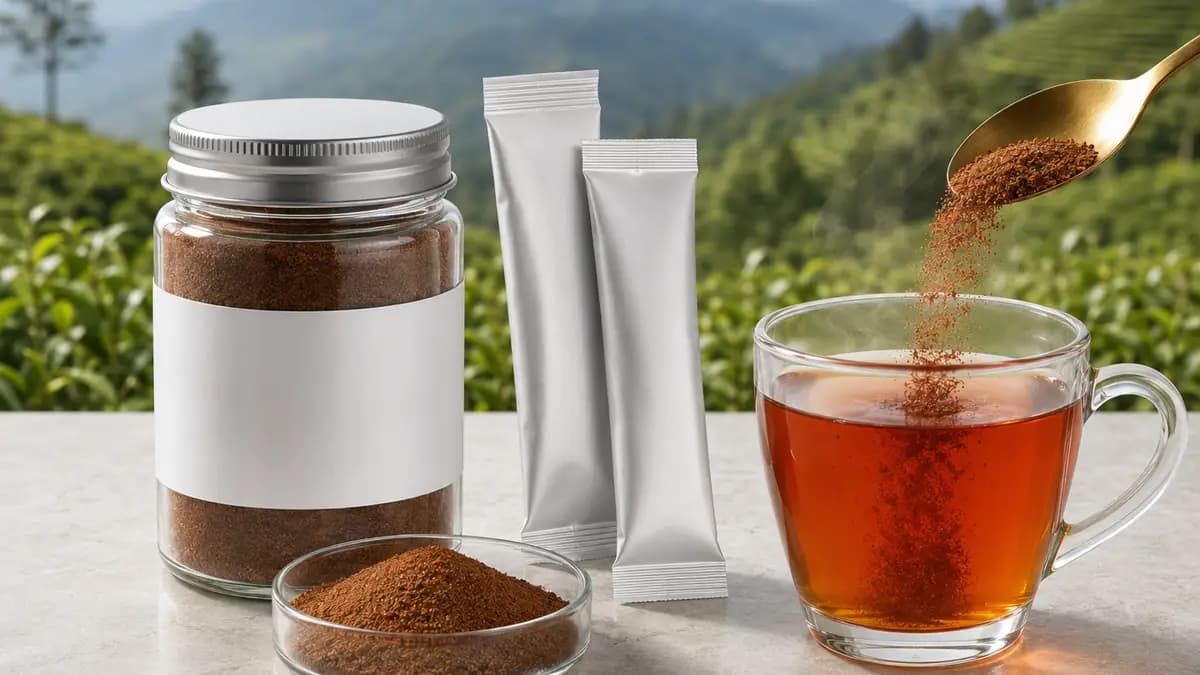
Instant tea powder is dried tea extract: brewed tea from which the water has been removed, leaving a powder that redissolves. Everything that makes one instant tea better than another happens in three decisions — which leaf goes in, how the extract is concentrated, and how it is dried. Price differences between suppliers almost always trace back to one of those three, not to margin.
How it is actually made
- Extraction — leaf is brewed in hot water, usually in stages, to pull soluble solids out of the leaf.
- Separation — spent leaf is filtered out; the liquid extract goes forward.
- Concentration — most of the water is removed under vacuum at reduced temperature, because boiling it off would cook the flavour.
- Drying — the concentrate becomes powder, by spray drying or freeze drying.
- Blending and standardisation — batches are adjusted so the finished powder hits a consistent solids and colour target.
Hot-water soluble versus cold-water soluble
This is the single most consequential line in an instant tea specification, and the one buyers most often leave out. Hot-water soluble (HWS) powder dissolves properly only above roughly 70 °C. Cold-water soluble (CWS) powder is processed further so that it dissolves in cold or iced water without hazing or settling.
| Hot-water soluble (HWS) | Cold-water soluble (CWS) | |
|---|---|---|
| Dissolves in | Hot water, above ~70 °C | Cold, ambient or hot water |
| Typical use | Vending, hot sachets, bakery, dairy dosing | Bottled and canned RTD, iced tea sticks, cold foam |
| Relative cost | Lower | Higher — extra processing |
| Behaviour in cold drinks | Hazes and sediments | Stays clear |
| Flavour intensity | Generally fuller | Slightly reduced by the extra processing |
If your product is ever going to meet cold water — an iced tea stick pack, a bottled drink, a cold foam topping — specify CWS. Buying HWS because it quotes cheaper and discovering the haze at pilot scale is the most common and most expensive mistake in this category.
Spray dried versus freeze dried
| Spray dried | Freeze dried | |
|---|---|---|
| Process | Concentrate sprayed into hot air | Concentrate frozen, water sublimated under vacuum |
| Aroma retention | Lower — volatiles are lost to heat | Higher |
| Particle | Fine, often agglomerated for flow | Porous, larger, crunchier |
| Cost | Lower | Substantially higher |
| Best for | Blended and flavoured drinks, high-volume RTD | Premium single-origin instant where aroma is the product |
The honest generalisation: if your drink is sweetened, flavoured or blended with milk, spray dried is the rational choice and the aroma difference will not survive the formulation anyway. If you are selling instant tea as tea — where the buyer is meant to notice the origin — freeze dried is worth the money.
Specification points that decide the outcome
| Parameter | Typical range | Why it matters |
|---|---|---|
| Solubility | HWS or CWS, stated explicitly | Governs whether the drink works at all |
| Moisture | ≤ 5% | Above this the powder cakes and shortens shelf life |
| Total polyphenols | Stated as a range | Drives astringency and colour depth |
| Caffeine | Stated as a range, or decaffeinated | Regulated labelling in several markets |
| Particle size / mesh | Stated range | Dosing accuracy and dissolution speed |
| Bulk density | Stated range | Sachet fill volume and freight |
| Colour in solution | Reference standard | Consumers judge iced tea by colour before taste |
| Ash | Stated maximum | Screens for over-extraction and adulteration |
Caffeine deserves a note. It varies with the leaf and the extraction, and it is a labelled value in several markets. Specify it as a range you can live with rather than accepting whatever arrives, and require the certificate of analysis to state the measured figure per lot.
Questions worth asking any instant tea supplier
- Do you extract in your own facility, or is it contract-manufactured? If contracted, can I audit that site?
- What leaf goes in — grade, origin, and is it the same leaf you sell as leaf tea?
- HWS or CWS, and at what temperature does it fully dissolve?
- Spray dried or freeze dried, and can I have both to compare in my formulation?
- What is the batch size, and how do you standardise between batches?
- What does the certificate of analysis cover per lot, and which laboratory issues it?
Question two separates suppliers more than any other. Instant tea is a natural home for leaf that could not be sold as leaf. That is not automatically wrong — extraction does not need a beautiful leaf appearance — but you are entitled to know, because it determines what your drink tastes like and whether the origin story on your label is true.