Articles
Hotel & Foodservice Tea Programmes: Formats, Costs & Sourcing
Room tea is one of the cheapest guest-perception levers in a hotel, and one of the most consistently mishandled.
Updated 2026-08-01 · 8 min read
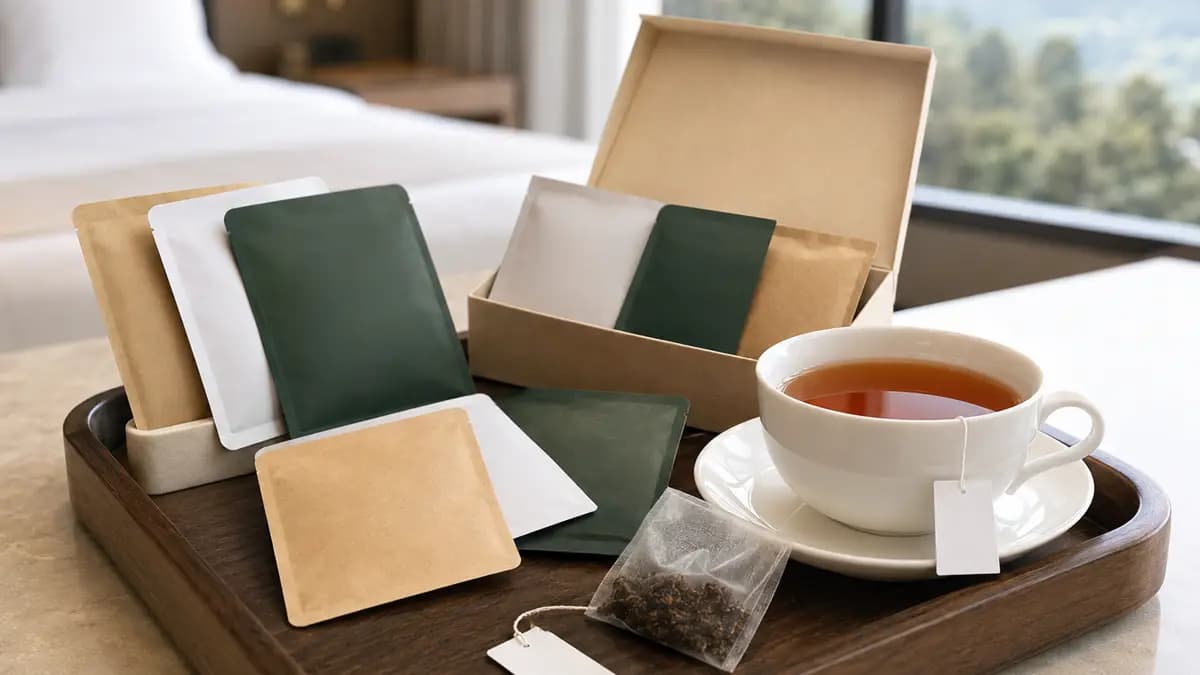
A hotel's tea programme costs very little per guest and is noticed disproportionately. At a 2 g fill, a kilogram of tea yields 500 servings — so even a substantial upgrade in leaf quality moves the cost per cup by a few cents while moving the guest's impression considerably.
The formats
| Format | Fill | Use | Typical MOQ |
|---|---|---|---|
| Foil-wrapped tagged sachet | 2 g | Guest rooms, turndown | 20,000 sachets |
| Pyramid bag | 2.5 – 4 g | Restaurant, lounge, afternoon tea | 10,000 bags |
| Flat foil sachet | 2 – 15 g | Banqueting, in-flight, sampling | 20,000 sachets |
| Bulk loose leaf | — | Full-service afternoon tea, brewing at scale | 25 kg |
| Presentation gift box | — | Retail in-property, VIP amenity | 500 sets |
Why the room sachet must be foil-wrapped
An unwrapped teabag sitting on a warm room tray absorbs ambient odour within weeks — cleaning products, carpet, air freshener, the minibar. Guests do not identify what is wrong; they simply register that the tea is unpleasant.
A sealed foil envelope solves this completely, and costs very little per unit. It is the single highest-return specification decision in a room amenity programme.
Costing it properly
Hotel procurement works in cost per cup and monthly consumption, not in kilo prices. The conversion is straightforward.
- Servings per kilogram = 1,000 ÷ fill weight in grams. At 2 g, that is 500.
- Cost per serving = kilo price ÷ servings per kilogram.
- Monthly consumption = rooms × occupancy × servings per room per night × 30.
- Add sachet, envelope and printing cost per unit for a finished-format programme.
Building the offer
A workable room selection is three to four items: one black tea, one green, one caffeine-free infusion, and optionally one flavoured. Beyond that, guests do not engage and housekeeping stocking becomes complicated.
For restaurant and afternoon-tea service, the calculation is different — there the tea is a menu item with a margin, and a single-origin tea with a story on the menu supports a price that a generic bag does not.
Regional considerations
- Gulf markets: highest per-property consumption globally, strong preference for premium presentation, and pronounced Ramadan and Eid peaks that must be ordered against months in advance.
- Europe: growing demand for compostable pyramid mesh and plastic-free packaging; expect it to be specified in tenders.
- Asia-Pacific: green tea and oolong lead; black tea is a secondary line.
- North America: strong growth in cold brew and iced service — worth specifying a grade that performs cold.
Practical procurement notes
- Lock artwork early; hotel branding approval cycles are slow and sit on the critical path.
- Order against a seasonal peak with a full lead time, not against current stock levels.
- Ask for mixed cases so housekeeping can restock a room in one movement.
- Specify shelf life and require production dates on cartons — hotel storerooms rotate poorly without them.
- Sample the finished format, not just the loose tea. How it brews in a room kettle is a different question from how it cups.