Articles
A Buyer's Guide to Tea Grading and Specification Sheets
The letter grades you know from Assam and Ceylon do not apply to Chinese tea. Here is what does.
Updated 2026-08-01 · 8 min read
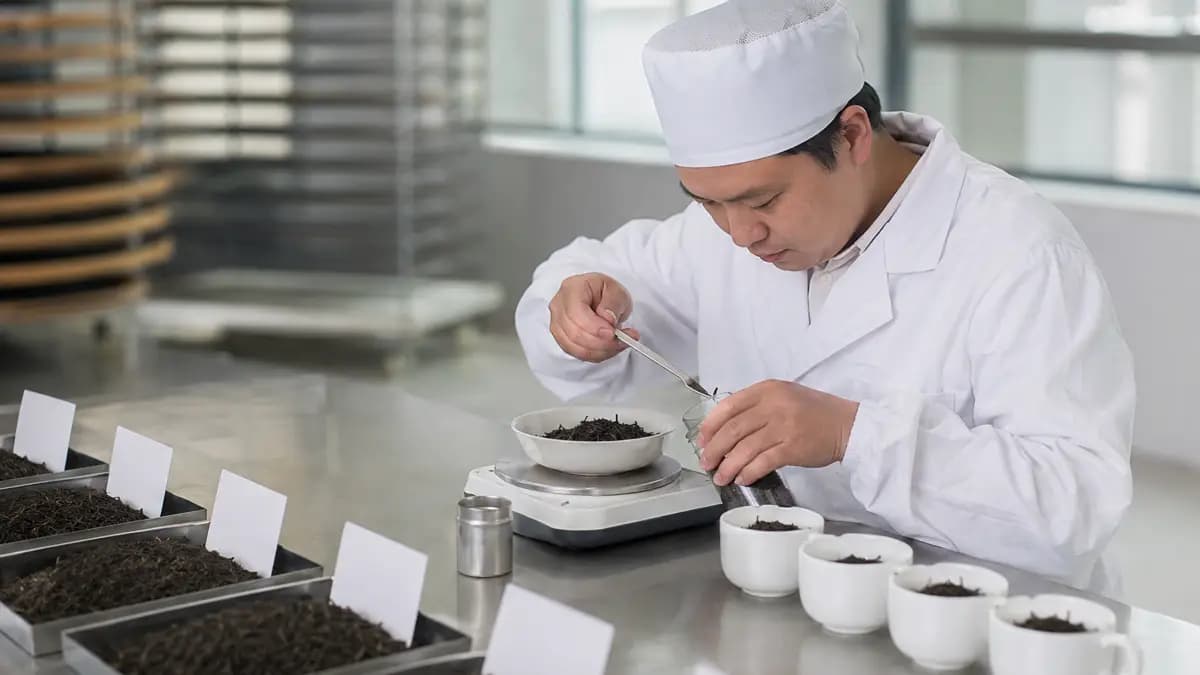
Chinese tea is not graded on the letter system used in India and Sri Lanka. A buyer who asks a Chinese producer for FTGFOP1 will get either a blank look or a salesperson happy to write whatever is asked for on the invoice — neither is useful.
The two systems
| Indian / Sri Lankan | Chinese | |
|---|---|---|
| Basis | Leaf size and appearance after sorting | Plucking standard and picking date |
| Notation | Letter codes (OP, FOP, FTGFOP…) | Descriptive: 单芽, 一芽一叶, 一芽二叶 |
| Implies quality? | Partly — indicates tip content and wholeness | Yes — directly reflects raw material |
| Standardised? | Broadly, within a producing country | By producer and by region, not nationally |
The Chinese approach describes what was picked. 单芽 (dan ya) is pure bud. 一芽一叶 (yi ya yi ye) is one bud and one leaf. 一芽二叶 is one bud and two leaves. Since younger material is scarcer and higher in amino acids, the plucking standard maps onto price directly.
What belongs on a specification sheet
A usable specification covers five areas. If a supplier cannot fill all five, they are probably trading rather than producing.
- Identity: product name, cultivar, geographical origin, harvest window, lot number, production date.
- Physical: plucking standard, appearance, moisture content, particle size for cut grades, foreign matter tolerance.
- Sensory: dry leaf, liquor colour, aroma, taste and infused leaf — the five-point Chinese cupping structure.
- Analytical: residue screen result, and where available amino acid, polyphenol and water extract figures.
- Commercial: packing format, net weight, shelf life, storage conditions, HS code, MOQ.
The numbers that actually predict quality
| Figure | What it tells you | Watch for |
|---|---|---|
| Moisture | Drying discipline and storage risk | ≤ 6.5% good; > 7% raises risk |
| Water extract | How much soluble matter is in the leaf | Higher generally means more body per gram |
| Amino acids | Sweetness and low astringency | Compare only within the same harvest window |
| Polyphenols | Astringency and structure | Read alongside amino acids, not alone |
| Whole-leaf ratio | Care in withering and rolling | Relevant for leaf grades, not for cut |
Cupping: the five-point structure
Chinese tasting practice assesses five things in fixed order, and a supplier's tasting notes should follow the same structure so you can compare offers directly.
- 外形 — dry leaf appearance: shape, colour, uniformity, tip content.
- 汤色 — liquor colour: hue, brightness, clarity. "Bright" is a quality judgement, not just a colour.
- 香气 — aroma: type, intensity, persistence.
- 滋味 — taste: sweetness, body, astringency, finish.
- 叶底 — infused leaf: colour uniformity, tenderness, evenness. This is where processing faults show most clearly.
Practical evaluation protocol
- Request samples from at least three suppliers for the same nominal specification.
- Cup blind, same water, same temperature, same ratio, same time.
- Score all five points, not just taste.
- Then compare against the specification sheets — a tea that tastes better than its paperwork suggests is a good sign; the reverse is a warning.
- Re-cup the approved sample against the first production shipment. This is the step that catches substitution.