Articles
Chinese Gongfu Black Tea Processing: The Six Steps Explained
There is almost no complete English-language explanation of Chinese gongfu black tea processing written for buyers rather than hobbyists. This is one.
Updated 2026-08-01 · 8 min read
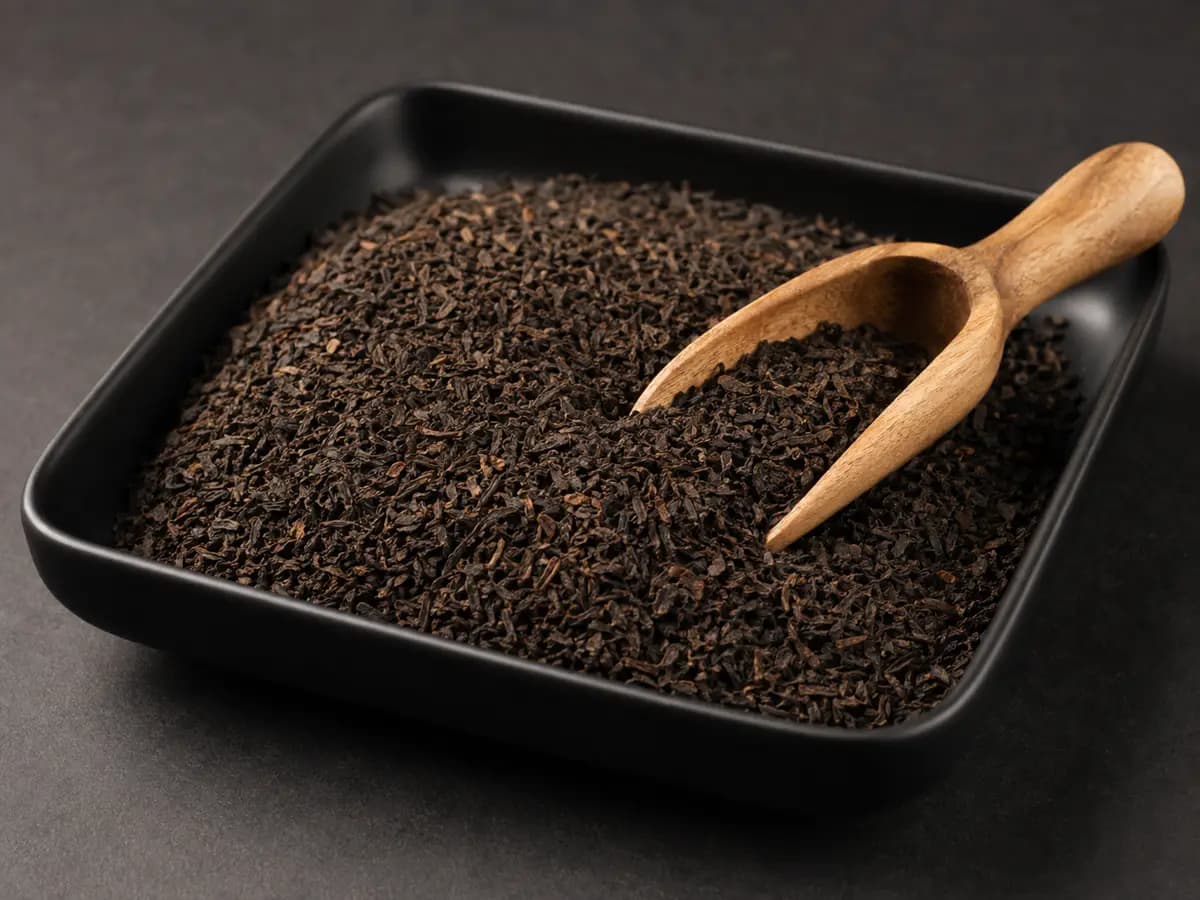
Orthodox Chinese black tea — 工夫红茶, gongfu hongcha — is made in six steps: withering, rolling, oxidation, drying, sorting and refiring, then quality control and packing. Each one is a place where quality is either created or lost, and understanding them is what lets a buyer read a specification sheet properly.
This is different from CTC (crush-tear-curl) production, which macerates the leaf mechanically to produce fast-extracting granules for teabags. CTC is a volume process; gongfu is a leaf-integrity process. Almost all Chinese black tea is orthodox.
1. Withering (萎凋)
Fresh leaf is spread on trays or troughs for 12–16 hours to lose moisture — typically from around 75% down to 60–62%. The purpose is physical: the leaf must become pliable enough to roll without tearing. A secondary chemical change starts here too, as proteins begin breaking down into amino acids.
Under-withering means the leaf shatters in the roller, producing broken grades and lost yield. Over-withering costs aroma irreversibly. Humidity and airflow are controlled; in Jishou, spring humidity means most withering is done indoors with forced air rather than on outdoor racks.
2. Rolling (揉捻)
The withered leaf is rolled in three stages of increasing pressure, typically 30–45 minutes each with de-balling between stages. Rolling does two things at once: it ruptures cell walls so that polyphenol oxidase can reach its substrates, and it gives the leaf its final twisted shape.
Pressure is the variable that matters. Too light and oxidation will be uneven; too heavy and the leaf breaks, which downgrades the whole batch.
3. Oxidation (发酵)
This is the step that makes black tea black, and the one most often mistranslated. The Chinese term 发酵 literally means fermentation, but no microbial fermentation is involved — it is enzymatic oxidation. Polyphenols convert into theaflavins and thearubigins, which produce the colour and much of the body of the finished liquor.
| Parameter | Typical range | Effect if wrong |
|---|---|---|
| Temperature | 22 – 28 °C | Too high: sour, flat. Too low: green, sharp |
| Relative humidity | 90 – 95% | Too low: uneven, dry edges |
| Duration | 3 – 5 hours | Judged by aroma and colour, not the clock alone |
| Leaf bed depth | 8 – 15 cm | Too deep: heat builds, oxidation runs away |
An experienced maker judges the endpoint by smell — the grassy note gives way to fruit and honey — and by colour, as the leaf turns from green through copper. This judgement is the single largest source of variation between producers working from identical leaf.
4. Drying (干燥)
Hot air arrests oxidation at the chosen point and brings moisture down to a storable level, usually under 6.5%. It is normally done in two passes with a rest between: a high-temperature first pass to kill enzyme activity quickly, then a lower-temperature second pass to finish.
Drying too fast case-hardens the leaf — the outside seals while the inside stays moist, and the tea deteriorates in storage regardless of how it is packed. Drying too slowly lets oxidation continue past the intended point.
5. Sorting and refiring (精制筛分)
The dried tea is screened by particle size, winnowed to remove fibre and stem, sometimes hand-picked, then refired to final moisture. Grade separation happens here: Imperial, Premium, Commercial and teabag cut all come off the same sorting line from the same original batch.
This is worth understanding as a buyer, because it explains why a producer can offer four grades of the same tea: they are not four different teas, they are four fractions of one production run.
6. Quality control and packing (审评与包装)
Every batch is cupped against retained reference samples, and sampled for residue analysis before release. Cleared batches are packed into foil-lined cartons with lot number and production date.
What this means for specification
- Moisture ≤ 6.5% indicates proper drying; above 7% raises storage risk.
- A high proportion of whole leaf indicates careful withering and rolling.
- Even colour in the infused leaf indicates uniform oxidation — patchy colour means it was rushed.
- Lot number and production date on the carton indicate a producer running actual batch control.