Articles
What Is Xiangxi Golden Tea? A Complete Guide
An registered Chinese geographical indication that almost nobody outside China has heard of — what it is, where it comes from, and why its composition is unusual.
Updated 2026-08-01 · 9 min read
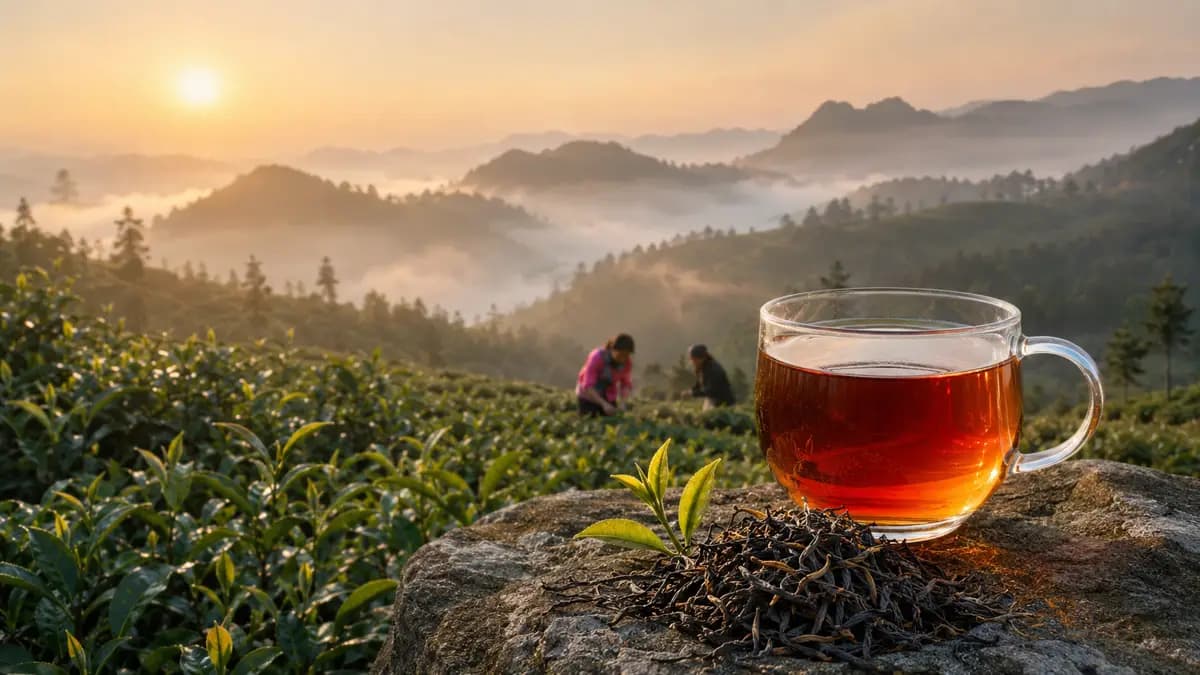
Xiangxi Golden Tea (湘西黄金茶) is a geographical-indication tea produced in Jishou, Xiangxi Tujia and Miao Autonomous Prefecture, Hunan Province, China. The name is protected as a Chinese geographical-indication certification mark, registration No. 15887938, covering the eight county-level divisions of Xiangxi prefecture, with Jishou as the core production area. Its validity was upheld by the Beijing High People's Court.
Despite that legal standing, it is close to unknown in Western markets. Most buyers sourcing Chinese black tea work from a short list — Keemun, Dianhong, Lapsang Souchong, Jin Jun Mei — that has not changed much in a century. This guide is for buyers who want to know what is behind the fourth or fifth name on that list.
Where it comes from
Jishou sits in the Wuling mountains of western Hunan, in an autonomous prefecture populated largely by Tujia and Miao communities. The gardens run between roughly 500 and 800 metres, on slopes that hold morning fog well into the growing season. The combination of altitude, latitude and persistent cloud cover produces slow leaf development, which is the general precondition for high amino acid accumulation in tea.
The geographical indication defines a specific production area. Tea grown outside it cannot legally use the name inside the EU or China, which is the practical difference between a GI and a brand: a brand tells you who made something, a GI tells you where it is from and lets you check.
The cultivars
Three cultivar selections carry the name commercially, usually referred to by number.
| Selection | Character | Principal use |
|---|---|---|
| No.1 (黄金1号) | Chestnut and broth, sweet, low astringency | Pre-Qingming green; post-Qingming black |
| No.2 (黄金2号) | High floral aroma, delicate body | Pre-Qingming green |
| No.8 (黄金8号) | Layered floral-to-honey, long return | Micro-lot green |
The composition data
What distinguishes this cultivar in analytical terms is described locally as the "four highs" (四高): amino acids, tea polyphenols, water extract and chlorophyll all measure high relative to comparable cultivars harvested in the same period.
| Component | Xiangxi Golden Tea | Typical cultivar | Ratio |
|---|---|---|---|
| Amino acids | 7.8% | ≈ 3.7% | ≈ 2.0× |
| Tea polyphenols | ≈ 20% | — | — |
| Water extract | ≈ 50% | — | — |
| Chlorophyll | +50% vs control | — | — |
The amino acid figure is the commercially relevant one. Amino acids — principally theanine — are what the palate reads as sweetness and body, while polyphenols are what it reads as astringency. A cultivar carrying roughly twice the amino acid content at a normal polyphenol level has an unusually favourable ratio between the two, and that is what buyers taste as "sweet with no bite".
The history
The local saying attached to this tea is 一两黄金一两茶 — "an ounce of gold for an ounce of tea." Its recorded origin is an episode in the Veritable Records of the Ming Dynasty (明世宗实录) for the fourth month of the eighteenth year of the Jiajing reign, corresponding to 1539, when the censor Lu Jie passed through the Baojing pacification commission — in this same prefecture — while inspecting border defences.
Tea cultivation in the area is considerably older than that episode. Local histories trace official tea production in the Qianling area to the Qin period, which is where the brand name Daqin — "Great Qin" — comes from.
Green tea and black tea from the same bushes
One point that confuses buyers new to the origin: Jishou produces both green and black tea from the same gardens, split by picking date rather than by cultivar or plot.
| Window | Chinese term | Approximate dates | Yields |
|---|---|---|---|
| Pre-Qingming | 明前 | Late March – approx. 5 April | Highest-grade green tea |
| Pre-Guyu | 雨前 | Approx. 5 – 20 April | Green tea, fuller body |
| Post-Qingming | 明后 | Mid-April – late May | Black tea, premium grades |
| Summer / autumn | 夏秋茶 | June – September | Commercial black tea, teabag cut |
How it compares
| Tea | Province | Characteristic aroma | Position |
|---|---|---|---|
| Xiangxi Golden Black | Hunan | Honey, stone fruit, faint orchid | Single-origin specialty, Chinese GI mark |
| Keemun | Anhui | Rose, pine smoke, cocoa | Classic export benchmark |
| Dianhong | Yunnan | Malt, sweet potato, cocoa | Full-bodied, tippy |
| Lapsang Souchong | Fujian | Pine smoke or longan | Origin of all black tea |
| Jin Jun Mei | Fujian | Honey, floral | Pure-bud luxury grade |
Should you source it?
The honest answer depends on what you are building. If you need commodity CTC at two dollars a kilo, this is the wrong origin and no amount of history will change that. If you are building a single-origin proposition and need something that is genuinely distinctive, verifiable and not already on every competitor's shelf, the combination of a public GI register entry and a reproducible composition figure is unusually strong ground to stand on.